WORLD FUTURE FUND
https://www.worldfuturefund.org
INTRODUCTION DESCRIPTION
CITIZEN
GUIDES READING
LIST SITE
INDEX
REPORTS
NEWS MULTIMEDIA
SEARCH HOW
TO CONTRIBUTE
HELP WANTED
VOLUNTEERS
GRANTS PUBLICATIONS
PRINCIPLES COPYRIGHT
NOTICE CONTACT
US
ISLAM'S LAWS OF WAR
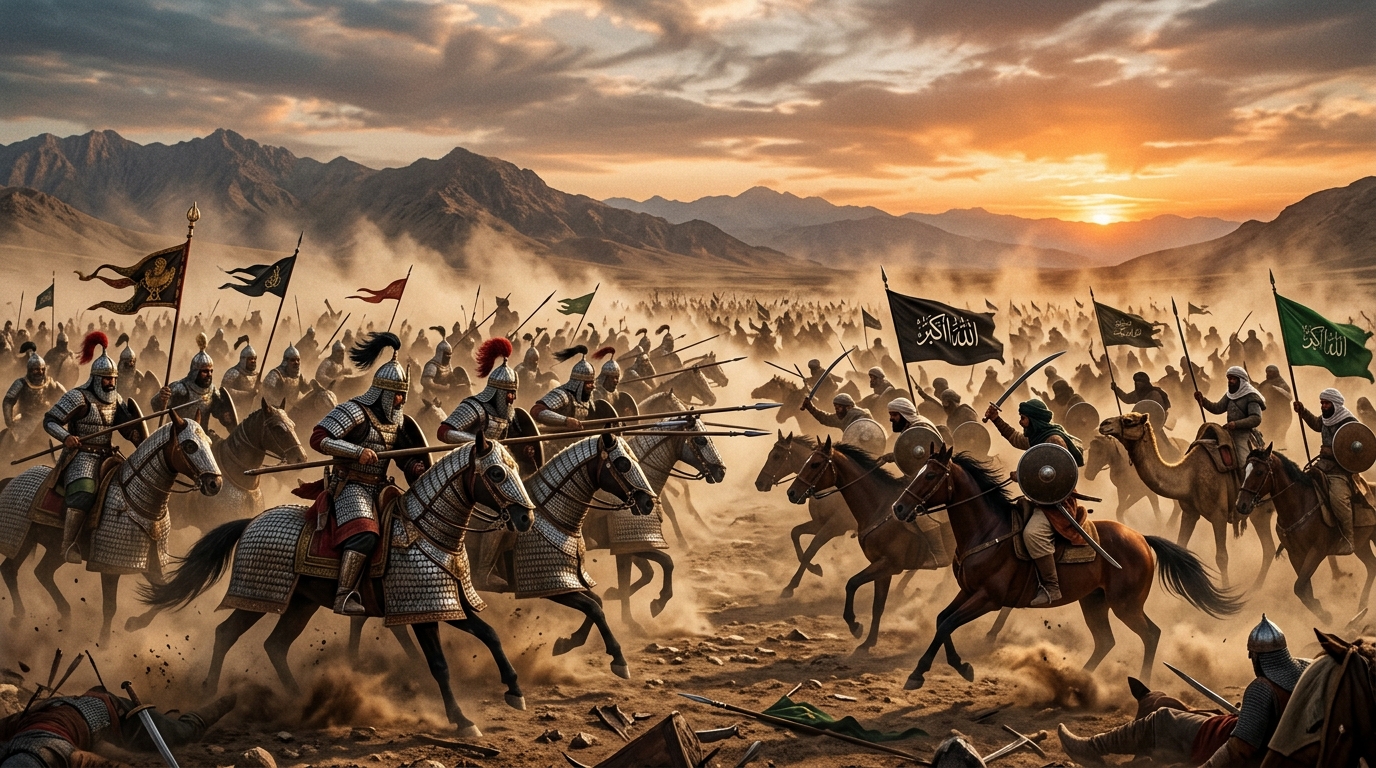
(Battle of Nahavand 642. Islam ends the Sassanid Persian Empire)
THE GREATEST RELIGIOUS REVOLUTION IN HISTORY
Within a hundred years of the Prophet Mohammed's
death, Islam had built one of the largest and most enduring empires the world
has ever seen. In terms of speed and scale, it rivaled the conquests of
Alexander the Great, but unlike Alexander's empire, which fragmented almost
immediately after his death, the Islamic caliphate held together as a unified
political and religious entity for centuries. This raises an obvious question:
how did an empire expand this quickly and still manage to hold itself together
for so long?
An answer lies largely in the policy of religious tolerance that
the early caliphs enforced as they conquered new territory, a policy rooted
directly in the teachings of the Quran. Nowhere is this more clear than in the conquest of the
Byzantine Empire's core territories, the Levant and Egypt. When Islamic armies
took control of these regions, they did not arrive to force conversion or wipe
out other faiths. Instead, they brought a system of tolerance that, for many
people living under Byzantine rule, amounted to genuine liberation. Christianity
had seized control of the Roman Empire in the fourth century, and what followed
was one of the most brutal periods of religious persecution in history. Entire
communities that practiced other faiths, or even different interpretations of
Christianity itself, were violently suppressed. People were killed simply for
believing differently than the state demanded. This is the same pattern of white
Christian violence discussed later in this piece, and it did not begin in the
colonial era. It began centuries earlier, under Rome.
When Islamic rule replaced Byzantine rule in these territories, that violence stopped almost overnight. Non-Muslims were required to pay the jizya tax and did not hold the same legal status as Muslim citizens, but beyond that, they were left alone to worship as they pleased. Compared to what came before, this was an extraordinary shift. The same pattern played out farther east, where the Sassanid Persian Empire was conquered and dissolved entirely. Neither of these conquests, against two of the most powerful empires of the age, could have succeeded and lasted the way they did without this underlying policy of tolerance. People living under these old empires had little reason to resist a new ruling power that offered them more freedom than the one it replaced.
This is the same principle seen later in Caliph Umar's
treatment of Jerusalem and in the Pact of Umar more broadly. It was not an
isolated act of mercy by one ruler. It was the foundation of how the early
caliphate built and sustained one of the largest empires in human history, and
it stands in direct contrast to the violent, coercive expansion so often
associated with religious conquest, whether people are willing to admit it or
not.
ABU BAKR’S TEN COMMANDMENTS FOR JUST WAR
The first Caliphs and the direct successor
to Muhammed, Abu Bakr, laid out ten laws for Jihad. According to the hadith al-Muwatta’ 918, when
dispatching armies for Syria, Abu Bakr said “I give you ten instructions: Do not
kill a woman, nor a child, nor an infirm elder. Do not cut down fruit-bearing
trees, nor tear down inhabited buildings. Do not slaughter sheep or camels,
except for food. Do not burn or drown bees nests. Do not steal from the spoils
and do not act cowardly.”
These ten rules recited by Abu Bakr are directly
inspired by what is written in the Quran. Because of the destructive nature of
warfare, there must be strict rules when fighting occurs as to not transgress.
Allah’s rules for Jihad and Abu Bakr’s interpretation of those rules directly
contradict the senseless and evil violence committed by bad faith actors in the
name of Islam.
These policies became a template for
the creation of Islam's giant empire.
THE CONQUEST OF JERUSALEM: MERCY IN VICTORY
If anyone wants proof that the rules of Jihad laid out
above were not just words on a page, look no further than the conquest of
Jerusalem under the second Rashidun Caliph, Umar ibn al-Khattab. Umar's forces
laid siege to the city in late 636, and after months of standing firm,
Sophronius, the Patriarch of Jerusalem, agreed to surrender the city, but only
to Umar himself. What followed was remarkable for its time and remains
remarkable today: the siege ended without a single drop of blood spilled. No
massacre, no looting, no burning of churches. This alone sets the conquest of
Jerusalem apart from nearly every other major military conquest in history,
Islamic or otherwise.
When Umar arrived to personally accept the surrender, he did not come as a conqueror seeking vengeance or plunder. He accepted the city on the condition that non-Muslims living there pay the jizya, the same tax discussed earlier in relation to Surah At-Tawbah, and in return he issued what is now known as Umar's Assurance. This guarantee promised the Christians of Jerusalem that their churches would not be destroyed, their property would not be seized, and they would be free to continue practicing their faith without interference. When Sophronius invited Umar to pray inside the Church of the Holy Sepulchre itself, Umar declined. He understood that if he prayed there, future Muslims might use that precedent to claim the church and convert it into a mosque. So instead, he prayed outside, a small act that showed a level of foresight and restraint rarely seen from any conquering ruler in any era. For the Jewish community, Umar's conquest meant something even greater: an end to roughly five centuries of exclusion and persecution under Roman rule, and the ability to finally return to the city they had been barred from for generations.
This pattern held throughout Umar's rule, not just in Jerusalem. Christians and Jews across the caliphate, who had suffered under Roman and Persian persecution, were granted rights and protections that were nearly unheard of in the seventh century. They were classified as dhimmi, or protected people, under what became known as the Pact of Umar. This status guaranteed their safety and their right to worship freely, and it exempted them from Islamic trade law, meaning Christians and Jews could continue conducting business according to their own religious and legal traditions rather than being forced to adopt someone else's. This was not tolerance in name only. It was written policy, backed by the authority of the caliphate itself, and it is a major reason the Islamic empire endured and expanded for centuries afterward.
The conquest of Jerusalem stands as a direct rebuttal to the idea that Islamic expansion was built on forced conversion and slaughter. Umar had every opportunity to sack the city, punish its residents, and erase its Christian and Jewish character. He did none of these things. Instead, he offered protection, religious freedom, and a peace agreement that both communities upheld for generations. This is the same spirit found in Abu Bakr's ten commandments and in the verses of the Quran that demand mercy even in the middle of war. Umar did not see these principles as obstacles to conquest. He saw them as the entire point of it.
It was a marked contrast to the mass
slaughter that followed the Crusaders conquest of Jerusalem in 1099.
ALLAH’S RULES FOR JIHAD ARE CLEAR
Jihad has become an extremely politicized term
especially in the post-9/11 world. Let us be clear – Jihad is not senseless
violence. Violence for its own sake, violence born out of hatred, is not what
Allah commands. This kind of violence can only be self-serving, and is not the
kind of Jihad Allah allows His followers to partake in. Because of the way Islam
is portrayed in the West, Jihad often gets conflated with terrorist acts. This
directly contradicts the teachings of the Quran, where it is written “fight in
the cause of Allah only against those who wage war against you, but do not
exceed the limits. Allah does not like transgressors” (2:190). It is made
explicitly clear in the Quran that during battle, one must never harm civilians
nor exceed the rules of war. The acts of violence terrorist groups commit are
not to serve Allah, but instead to advance their own agendas on Earth. Struggle
itself is not inherently violent: it is resiliency combined with faith. That
being said however, there are times in which violence may be the only option to
defend oneself against an oppressive force, such as in the Battle of Badr.
JIHAD IS OBLIGATORY
In the Holy Quran, it is written “fighting has been
made obligatory upon you believers, though you dislike it. Perhaps you dislike
something which is good for you and like something which is bad for you. Allah
knows and you do not know” (2:216). In Islam, struggle is not merely allowed in
the face of adversity, it is mandatory. However, living in a time when
throughout the Islamic world, struggle is needed more than ever, we believe it
is necessary to revisit a core tenant of Islam that often gets misinterpreted –
Jihad.
SELF-DEFENSE IN EARLY ISLAM
In the Quran, it is explicitly stated that Muslims
have the right to self-defense. In the twenty-second Surah, verse 39, it is
written “permission to fight back is hereby granted to those being fought, for
they have been wronged. And Allah is truly Most Capable of helping them prevail”
(22:39). To understand what this means in the context Islam, we must look at
early Islamic history, specifically the life of and the conquests of the Prophet
Mohammed. After the angel Gabriel revealed himself and gave the word of Allah to
Mohammed, the Prophet began preaching His word in Mecca. At first, the Quraysh
tribe which controlled Mecca of the time ignored Mohammed, and they wrote him
off as someone of little importance. However, as he gained more followers and
continued to preach monotheism, he and the Muslims started to face constant
persecution from the Quraysh. Eventually, this led to the Hijrah, the Muslim
journey to Medina. After the Muslims were expelled from Mecca, the Quraysh
confiscated all of their property and land they left behind. Now that Mohammed
had reestablished himself in Medina, the Muslims could finally fight back. Since
the Muslims had been so wronged by the Quraysh, Mohammed made the decision to
attack Quraysh trading caravans, many of which could contain property that were
confiscated from the Muslims. This led to many battles with the Quraysh,
including the Battle of Badr.
THE FATEFUL BATTLE OF BADR: A MIRACLE
We want to emphasize the second line in the 22:39
Quran verse: “and Allah is truly Most Capable of helping them prevail.” During
the Battle of Badr, the Muslims were severely outnumbered; the Quraysh had three
times more men than they had. The leader of this Quraysh force, Amir ibn Hisham,
hated the Muslims with a fiery passion. And yet, despite having 300 men to
Hisham’s 1000, the Muslims won decisively. Mohammed’s army seemed to do the
impossible. The faith of Mohammed’s men allowed them to perform a miraculous
victory. This marked a turning point in Mohammed’s struggle; the Battle of Badr
was the first major battle fought by the Muslims, beginning a half-millennium of
Islamic dominance.
STRUGGLE IS SACRIFICE
Struggle, however, is never easy. In the third Surah
of the Quran, verse 92, it is written “you will never achieve righteousness
until you donate some of what you cherish. And whatever you give is certainly
well known to Allah” (3:92). To struggle is not a simple task. It requires
self-sacrifice, to put one’s own personal safety at risk in order to fight for
what one believes in. The early Muslims risked everything and sacrificed most of
their worldly possessions to serve Allah and fight for His prophet. In the third
Surah, verse 142 in the Quran, it is written: “do you think you will enter
Paradise without Allah proving which of you truly struggled for His cause and
patiently endured?” (3:142). Struggle and sacrifice are central to Islam.
So, we have established that Jihad or struggle is a
core tenant of Islam. We have also established that holy war can only be carried
out if one does not harm civilians, does not transgress, and does not exceed the
rules of engagement. Yet despite this, Western governments and Western media
look down on Islam and use Jihad as an example of how Islam is a dangerous and
violent religion.
THE NINTH SURAH OF THE QURAN
If there is one chapter that gets ripped out of
context more than any other, it's Surah At-Tawbah, the ninth chapter of the
Quran. Verse 5 is the one people love to quote on its own: "then kill the
polytheists wherever you find them, capture them, besiege them, and lie in wait
for them at every outpost" (9:5). Taken by itself, this line gets used
constantly as proof that Islam demands violence against non-believers
everywhere. But whoever quotes it this way always leaves out the verse right
before it and the verse right after it.
Verse 4 makes clear this isn't a blanket command. It says to honor treaties with polytheists who kept their word: "As for the polytheists who have honored their treaty with you and never supported anyone against you, honor your treaty with them until the end of its term" (9:4). Verse 5 was aimed at specific tribes near Mecca who had broken their agreements and attacked the Muslims first. It wasn't a general order against non-believers as a whole. And right after the so called "sword verse," Allah tells the Muslims to protect anyone from that same group who wants peace: "if any one of the polytheists asks you for refuge, grant it to them so that they may hear the word of Allah, then escort them to a place of safety" (9:6). That is not the language of wiping people out. That's the language of a conditional response to broken treaties, with real protections built in for anyone who wants out.
Verse 29 gets the same treatment. It talks about fighting non-believers "until they pay the tax, willingly submitting, fully humbled" (9:29), and critics love to hold this up as proof of religious persecution. What usually gets left out is that this tax, known as jizya, was tied to a specific political situation with communities who had taken up arms against the early Muslim state. In exchange for paying it, those communities were exempt from military service and placed under state protection. It described the terms of one particular conflict. It was never meant to be a permanent rule for how Muslims treat non-Muslims for all time.
None of this means Islamic history has no violence in
it, or that Surah At-Tawbah is somehow a comfortable read. Groups like ISIS
quote these same verses while skipping past their own built-in limits, the same
way they ignore Abu Bakr's ten commandments and the self-defense permission in
22:39. That's really the pattern running through this whole piece. Terrorists
who claim the name of Jihad and Western commentators who quote a single verse
out of forty are doing the same thing: stripping away context to serve an
agenda. Read in full, At-Tawbah doesn't throw out the limits on warfare found
everywhere else in the Quran. It reinforces them, mercy and treaty-honoring
built right into the chapter people point to as proof that Islam has none.
500 YEARS OF WHITE CHRISTIAN MASS VIOLENCE
In the last 500 years, the West has committed more
atrocities against civilians than in the entire 1,400-year history of Islam.
There is a 500-year history of genocide. There is the cration of the
world's largest and most brutal slave trade.
Even more disturbing has been the creation of an economic system based on the destruction of all life on the planet.
The American vcitory in the Cold War
raised hopes of a world of peace and freedom. Those hopes were dashed by
America's behavior. According to Brown University’s Costs of War Project,
America spent over 8 trillion dollars on a campaign of imperialism that killed
over 4 million people during America’s holy crusade otherwise known as the Global War on
Terror. This is likely a low estimate.
More recently, it is estimated that the
deaths in the American-backed Israeli genocide in Gaza is in the hundreds of
thousands, with a high percentage of the dead being children. There is no real
way to know how many Palestinians have been murdered since October 2023, but
some estimates range from 400 thousand to 600 thousand. The millions murdered by
America and the West that we have mentioned are only some examples of the
countless civilians that the West has murdered in the last 100 years. If we were
to go back even further to the beginning of colonialism, the dead would be
counted in the hundreds of millions.
A BETTER WORLD IS POSSIBLE
This begs the question—is there any alternative to
white Christian imperialism? Yes, we believe a better world is possible. Though
we do not endorse any religions, we believe deeply in religious tolerance. As
human beings, we should be against atrocities committed in the name of any
religion, whether it be Islamic terrorism, Christian colonialism, or Zionist
genocide. Though there are violent terrorist groups that claim to be Muslim such
as ISIS and Al-Qaeda, it is clear that white Christian terrorism has wiped out
millions more than even the most violent radical Muslims could even dream of.
All people should fight against atrocities, no matter who commits them. As the
reverend Dr. Martin Luther King Jr. famously said, “we must all learn to live
together as brothers, or we will all perish together as fools.”
The laws of war put forth by Islam's
first Caliph could certainly be a model for what is needed.
Links
Battle of Badr: Islam’s First Arrow– HistoryMarche
Video
Yasir Qadhi Battle of Badr Lecture
How Abu Bakr Prepared to Defeat Two Superpowers – Islamic Story Lens
Video
Why Abu Bakr Attacked Rome Same Time as Persia – Islamic Story Lens
Video